
Portugal
Costa Alentejana
Portugal's wildest coast — wheat fields, cork oaks, and Atlantic cliffs.
Best season
May–October
Perfect stay
4–7 days
Closest airport
Faro · 2h / Lisbon · 2h30
Overview
What makes Costa Alentejana special
- Part of the Southwest Alentejo and Vicentine Coast Natural Park — one of Europe's largest protected coastal areas
- Beaches rated among Portugal's best: Zambujeira do Mar, Praia da Odeceixe, Praia do Amado
- Rolling Alentejo farmland right up to dramatic Atlantic cliffs — the landscape shifts constantly
- Strong surf culture — consistent Atlantic swells, several world-class breaks
- Some of Portugal's most ambitious farm-to-table projects are based here
- Almost no mass tourism — small villages, working farms, empty roads
The Story
The Alentejo coast is what happens when farmland and Atlantic collide. Unlike the Algarve to the south — which was developed early and heavily — this stretch of coast was protected in 1995 as part of Portugal's Southwest Alentejo and Vicentine Coast Natural Park. The result is one of the last truly wild coastal stretches in Western Europe.
The landscape is particular: the interior is Alentejo — cork oak, wheat, hot dry summers, big skies — and then the land drops sharply to cliffs and beaches that face the full force of the Atlantic. The water is cold. The waves are serious. The beaches are often empty even in summer.
The towns are small. Zambujeira do Mar is a cluster of white houses above a beach that has no business being as beautiful as it is. Odeceixe is where a river meets the sea. Vila Nova de Milfontes is the largest town on this coast, which tells you something about the scale of development here.
A generation of food-minded Portuguese have come here to farm, grow and cook — drawn by the land, the climate and the space to do things properly. The Costa Alentejana now has some of the country's most interesting farm stays and restaurants operating out of converted farmhouses.
Don't Miss
Zambujeira do Mar
A small village on a cliff above a dramatic beach — turquoise water, steep path down, no development along the shore. One of Portugal's most beautiful beaches.
Parque Natural do Sudoeste Alentejano
The protected natural park covering most of this coast — wild cliff walks, endemic plant species, migrating birds. The Rota Vicentina walking trail runs through it.
Praia da Odeceixe
Where the Seixe river meets the Atlantic — a sheltered bay with calm water on one side and Atlantic waves on the other. Popular with families and surfers simultaneously.
Things To Do
Surf at Praia do Amado
One of the coast's most consistent surf breaks — school-friendly but also serious enough for experienced surfers. Wide beach, reliable Atlantic swell.
Stay Here
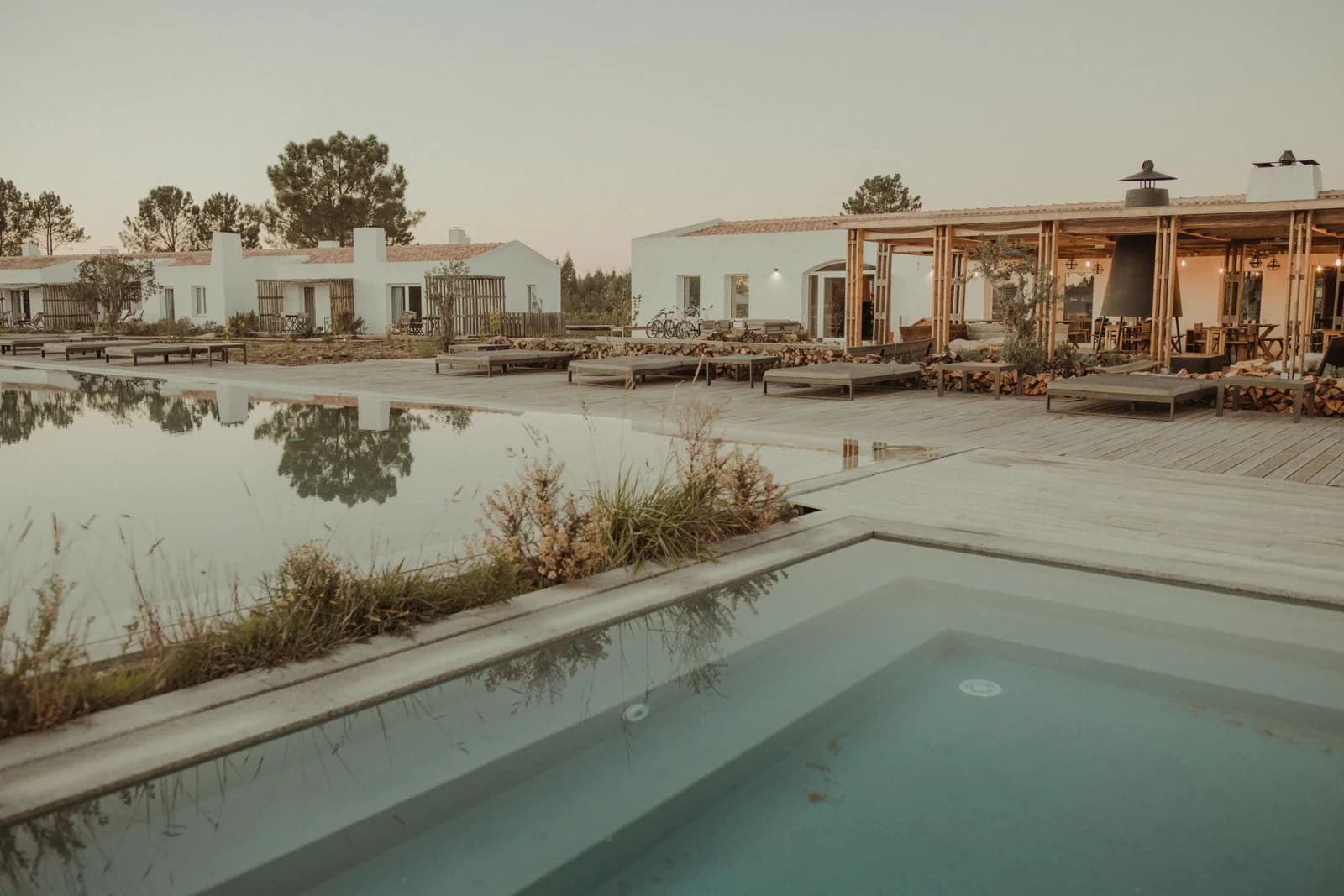 N°01São Teotónio · 15 min from Zambujeira do Mar
Craveiral Farmhouse
GroundedCreativePet-friendlyFeet on the ground, air of the sea — 38 houses between the Alentejo plains and the Atlantic.
The CinCin Notes
The Costa Alentejana is one of those places that makes you question why you'd go anywhere else. Wild coast, good food, working farms that have been transformed into some of the most interesting places to stay in Portugal.
Craveiral Farmhouse is the best example of what this coast has become: a working farm between the Alentejo plains and the Atlantic, with 38 houses, a restaurant that uses what the garden produces, and the kind of unhurried quality you get when people have thought seriously about what they're building.
Come for at least five days. Walk a section of the Rota Vicentina. Eat at the farmhouse. Drive to Zambujeira. The coast rewards time.